


Ειδικές Πληροφορίες για τον Καλλιτέχνη

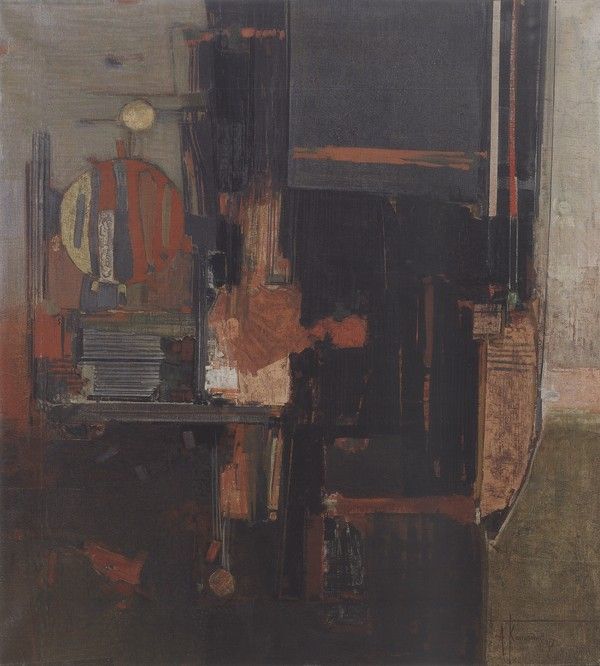
TITΛΟΣ ΕΡΓΟΥLES TRESORS DE L'AU DELA
ΔΙΑΣΤΑΣΕΙΣ ΕΡΓΟΥΎψος : 110
Πλάτος : 100
ΥΛΙΚΟ ΚΑΤΑΣΚΕΥΗΣΕλαιογραφία (Λάδι σε καμβά)
ΥΠΟΓΡΑΦΗ ΚΑΛΛΙΤΕΧΝΗΚάτω Δεξιά
ΧΡΟΝΟΛΟΓΗΣΗ01-01-1967
ΕΛΕΓΧΟΣ ΓΝΗΣΙΟΤΗΤΑΣΔεν έχει ελεγχθεί
Provenance:
I. Sklivaniotis collection, Athens.
Private collection, London.
Exhibited:
Athens, National Gallery and Alexander Soutzos Museum, Retrospective, 1976, no 95.
Lamia, Municipal Gallery, Retrospective, 1996 p. 98, fig. 50 (illustrated in the catalogue).
Literature:
Alecos Condopoulos, Athens 1979, fig. 245 (illustrated).
The painter is an organizer of dreams
A. Condopoulos
A brilliant synthesis of liberated, painterly drawing and disciplined fields of colour, Les tresors de lau-delà consists of a dialectic between the conscious and the unconscious, reflecting Condopoulos sensitive response to the nature of contemporary experience. Straight lines and shredded shapes, weighted colours and lyrical tones, solid volumes and gestural markings gently overlap and interlock in a quest for the perfect balance between order and emotion, rational structure and romantic expressiveness. In his own preface to his 1969 show, Condopoulos aptly noted that the artists goal is to orderly assemble disparate elements in order to discover poetic compositions of a given meter and rhythm.1
Here, Condopoulos builds up a robust architectural edifice of geometric forms distributed along a series of strong verticals and horizontals, capable of relating the picture plane to the rectangular shape of the canvas, which ultimately echo the painters lifelong studies in classical art. This austere compositional structure, complemented by free, apparently accidental, but essentially deliberate brushstrokes, is set in motion while retaining a coherent inner rhythm.2 The vibrating texture contributes a smooth and steady beat to the movement, bringing the picture closer to music, an art form that expresses poetic feeling without referring to objective reality.
Though the painting can be read as a totally non-objective landscape of abstract marks, certain indiscernible extra visual references (such as the suggestion of a precipitous ravine opening up to a distant seascape) allude to the real, echoing Condopoulos earlier commitment to realism and foreshadowing his enigmatic symbolist period of the 1970s. As noted by Professor C. Christou, a significant change in the work of Condopoulos is detected as early as 1966, with the introduction of an expressionist vocabulary, pronounced colour juxtapositions, rather aggressive shapes and a relatively undulating surface. Especially since 1967, one should note the utilisation of additional elements, such as calligraphic motifs or geometric themes that endow his painting with new expressive possibilities. In certain cases, moreover, a rather decorative disposition emerges, based on gentle colouring and the combination of geometric and calligraphic patterns. In works such as Les tresors de lau-delà, Condopoulos reaches compositions that express an inward and poetic vision.3
This sense of poetic reverie and spiritual contemplation in a transcendental landscape lit by a strange, otherworldly light and supported by the works title (Treasures of the unseen), charges the paintings subject matter with a strong metaphysical import, echoing Condopoulos own words: The true nature of a work of art is nothing less than a striving to transcend. The artists conscience seeks to discover the secret relationships that bind humankind with the mythical and the transcendental and, following that, to express the very core of human existence along with anything else that can only be rendered through art.4
Such emphasis on archetypal cosmic symbols imbued with everlasting value and bipolar structures of meaning that allude to the eternal struggle between human nature and divine reason, reflects the aspiration of abstract art to express through universal imagery the collective consciousness of mankind. However, as keenly pointed out by Professor S. Lydakis, Condopoulos abstraction did not acquire the expressionist vehemence it took on in the West, nor did it adopt the purist-austere principles of constructivism, but rather adhered to a subjective poetic freedom, a subjective poetry, as the artist himself once said, that evolves without limitations in the infinite realm of imagination.5
1. A. Condopoulos, 26 Recent Paintings and a Brief Retrospect [in Greek], Athens Hilton Art Gallery, 1969.
2. H. Kambouridis - G. Levounis, Modern Greek Art-The 20th Century, Ministry of the Aegean, Athens 1999, p. 154.
3. C. Christou, Alecos Condopoulos [in Greek] in Alecos Condopoulos, Retrospective, exhibition catalogue, A. Condopoulos Municipal Gallery of Lamia, Lamia 1996, pp. 52-53.
4. A. Condopoulos, Making Art a Remembrance, Essays on Aesthetics [in Greek], Athens 1971, pp. 43-44.
5. S. Lydakis, Eorga, Alecos Condopoulos, the Man and his Work [in Greek], Melissa publ., Athens 1975, p. 14.